Cavite is a province in the CALABARZON region, immediately south of Metro Manila across Manila Bay. Its position adjacent to the capital has made it simultaneously a strategic military asset, an industrialized urban extension, and the birthplace of the Philippine Revolution. The Katipunan uprising began here in 1896, and several of the revolution's most consequential events played out on Cavite soil. Today the province is one of the most densely populated and economically productive in the Philippines.
Trece Martires CityCapital
1,575 km²Area
23Municipalities
7Cities
LuzonIsland Group
CALABARZON (IV-A)Region
The Cradle of Revolution
The provincial identity is anchored in the 1896 revolution. Cavite was where the Katipunan's armed uprising began, where the first significant revolutionary victories were won, where Emilio Aguinaldo emerged as a military leader, and where the tensions between Bonifacio's plebeian Magdiwang and Aguinaldo's elite Magdalo factions played out to their fatal conclusion. Every school-age Filipino knows the name of the Cry of Pugad Lawin — the event that launched the revolution — and Cavite's central role in what followed.
★
Did You Know?The execution of José Rizal at Bagumbayan (Luneta) on December 30, 1896 was intended to discourage the revolution already underway in Cavite. It had the opposite effect.
Cavite's strategic importance as a harbor and naval base made it one of the most significant provinces in the colonial Philippines. The Spanish established their principal naval base at Cavite City, and the bay served as the staging point for galleon voyages and military expeditions. This military importance made Cavite wealthy and educated, producing the ilustrado class that would lead the revolution.
1571Spanish Establish Cavite Port
The Spanish make Cavite their primary naval base in the Philippines, recognizing its sheltered harbor along Manila Bay. The port becomes the most important in the archipelago.
1762British Occupation
British forces capture Manila and Cavite during the Seven Years' War. They hold the area for two years before withdrawing under the 1763 Treaty of Paris.
1872Cavite Mutiny
A mutiny by Filipino soldiers at the Cavite arsenal is suppressed by Spanish authorities. Three secular Filipino priests — Gomez, Burgos, and Zamora (Gomburza) — are executed on fabricated charges of complicity. Their execution radicalizes a generation of Filipino nationalists, including the young José Rizal.
August 23, 1896Cry of Pugad Lawin
Andres Bonifacio and Katipunan members tear their cedulas (tax certificates) in a declaration of revolt against Spain. The uprising quickly spreads to Cavite, where Katipunan forces win their first significant military victories.
March 1897Tejeros Convention
A revolutionary assembly at Tejeros, Cavite elects Emilio Aguinaldo as president of the revolutionary government, supplanting Andres Bonifacio. Bonifacio disputes the results and is subsequently arrested, tried, and executed on Aguinaldo's orders in May 1897.
May 1, 1898Battle of Manila Bay
US Admiral Dewey destroys the Spanish fleet in Manila Bay. Cavite City's naval arsenal is captured, ending Spanish naval power in the Philippines and opening the way for American intervention.
1942–1945World War II
Japanese forces occupy Cavite. The Bataan Death March began from the peninsula adjacent to Cavite. Cavite City suffers heavy damage during the 1945 liberation campaign.
Cavite's culture is shaped by its proximity to Manila, its naval history, and its revolutionary heritage. The province is primarily Tagalog-speaking, but Cavite City has a Chabacano-speaking community descended from Zamboanga migrants and the Spanish colonial naval establishment — a linguistic island in a Tagalog sea.
The Revolutionary Memory
The revolution is not a distant event in Cavite — it is a source of active provincial identity. Municipalities carry the names of revolutionary events and heroes. The Bonifacio-Aguinaldo conflict, which resulted in Bonifacio's execution, remains a sensitive historical topic: Caviteños are Aguinaldo's people, and the story is told differently here than in Manila or in Binakayan.
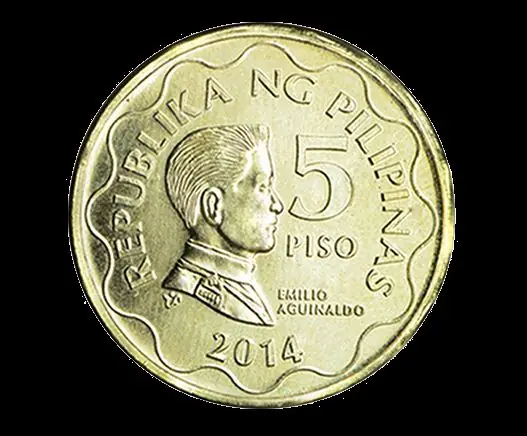
Emilio Aguinaldo
General, First Philippine President1869–1964Born in Kawit, Cavite, Aguinaldo led the Magdiwang faction of Cavite revolutionaries and emerged as the dominant military and political leader of the Philippine Revolution after the Tejeros Convention. He proclaimed Philippine independence from his window in Kawit on June 12, 1898, and became the first president of the Philippine Republic. He surrendered to American forces in 1901 and lived in Kawit until his death at age 94.
★
Chabacano of CaviteCavite City has a distinct variety of Chabacano — the Spanish-based creole language — different from the Chabacano of Zamboanga. It is called Caviteño Chabacano and is spoken by a community descended from 17th-century Zamboangueño laborers brought to the naval arsenal.
Cavite's food tradition is broadly Tagalog but with influences from its naval history and its proximity to the sea. The province is known for specific local preparations, particularly those associated with Cavite City's old quarters, where Spanish colonial and Chinese trading influences merged with Tagalog cooking.
Bacalao a la Vizcaina (Cavite Style)
Salt cod cooked in a tomato-based sauce with olives, capers, and pimientos. A Spanish colonial preparation that survived in Cavite City's Chabacano community and in the broader Cavite heritage food tradition. It is served at Lenten meals and family celebrations.
Sinampalokan na Manok
Chicken soured with tamarind (sampalok), a classic Tagalog preparation common throughout Cavite. The tamarind sourness is pronounced — more than in most sinigang preparations — and the broth is thin rather than thickened. Eaten with plain white rice.
20 minutesPrep
30 minutesCook
4Serves
Ingredients
- 600gFresh squid, cleaned
- 6 cloves, mincedGarlic
- 1 large, slicedOnion
- ¼ cupVinegar (cane or coconut)
- 3 tablespoonsSoy sauce
- 2Bay leaves
- 1 teaspoon, crackedBlack pepper
- 2 tablespoonsCooking oil
- ½ cupWater
Method
- Clean squid: remove quill and innards, keeping the ink sac separate. Peel skin. Cut bodies into rings, leave tentacles whole.
- Sauté garlic and onion in oil until soft.
- Add squid and stir-fry 2 minutes.
- Add vinegar. Do not stir for 1 minute — let vinegar cook off raw sharpness.
- Add soy sauce, bay leaves, cracked pepper, and water. Add squid ink if desired for a darker, richer sauce.
- Simmer uncovered 20–25 minutes until squid is tender and sauce reduces.
- Taste and adjust seasoning. Serve with rice.
Cook's noteSquid becomes rubbery if overcooked quickly, then tender again with extended slow cooking. The 25-minute simmer is the right approach — do not attempt a quick high-heat version. The ink, if used, thickens the sauce and adds depth.
Tamales Caviteño
A distinct variation on tamales — ground rice and coconut milk steamed in banana leaf packets with toppings of boiled egg, salted egg, chorizo, and peanuts. Unlike Mexican tamales, the Cavite version uses rice rather than corn masa. It is an old dish, likely reflecting Chinese and Spanish colonial influences, and is served as a snack or merienda.
Tagalog is the primary language of Cavite province, continuous with the Tagalog spoken in Metro Manila and Batangas. The exception is Cavite City, which has a Chabacano-speaking community — a Spanish-based creole language distinct from but related to the Chabacano of Zamboanga City in Mindanao.
TagalogProvincial language
Caviteño Chabacano + TagalogCavite City
Diminishing communityChabacano speakers
Filipino, EnglishOfficial
Caviteño Chabacano is an endangered language. Younger generations in Cavite City are primarily Tagalog speakers, and the Chabacano community has shrunk significantly over the 20th century. Linguistic documentation and revitalization efforts exist but face the practical difficulties of a small urban speech community surrounded by a dominant regional language.
★
Two ChabacanosCaviteño Chabacano and Zamboangueño Chabacano are not mutually intelligible despite sharing Spanish as their lexical base. They developed independently from different contact situations and have diverged significantly over four centuries.
Cavite is one of the easiest provinces to reach from Manila — much of the province has been absorbed into the Metro Manila urban sprawl. The Cavite Expressway (CAVITEX) and Aguinaldo Highway link the province directly to Manila. Cavite City, the old Spanish naval base, is about 35 kilometers from Manila by road. The province's heritage sites are concentrated in Kawit, Cavite City, and a few interior municipalities.
30–60 min (CAVITEX)From Manila
Fast craft Manila–Cavite ~25 minBy ferry
NAIA, ManilaNearest airport
Heritage, day tripsBest for
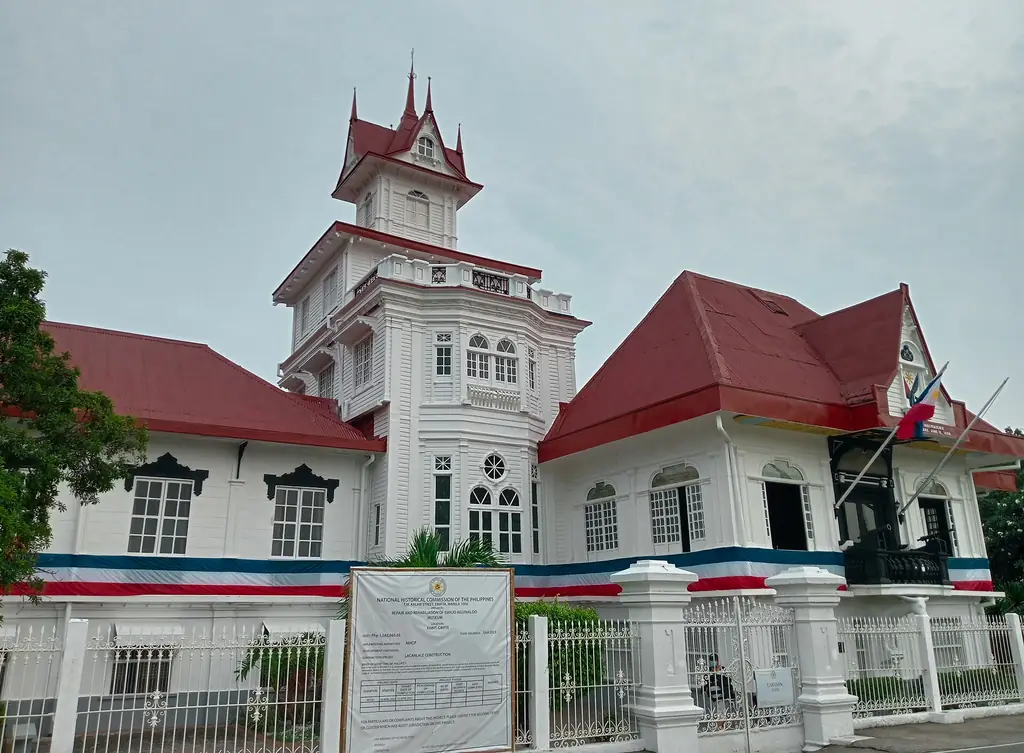
Aguinaldo Shrine, Kawit
The ancestral home of Emilio Aguinaldo in Kawit, where he proclaimed Philippine independence on June 12, 1898. The two-story house is maintained as a national shrine and museum. The window from which Aguinaldo read the declaration is preserved, as are the flag, the ceremonial band's instruments, and extensive personal artifacts. Required visiting for anyone studying Philippine history.
Corregidor Island
An island fortress at the mouth of Manila Bay, technically part of Cavite waters. Corregidor was the last American-Filipino defense position before the fall of the Philippines in 1942. The island is covered with WWII ruins — barracks, gun emplacements, a hospital — and a museum. Day trips operate from Manila's CCP complex pier.
Cavite City Heritage Zone
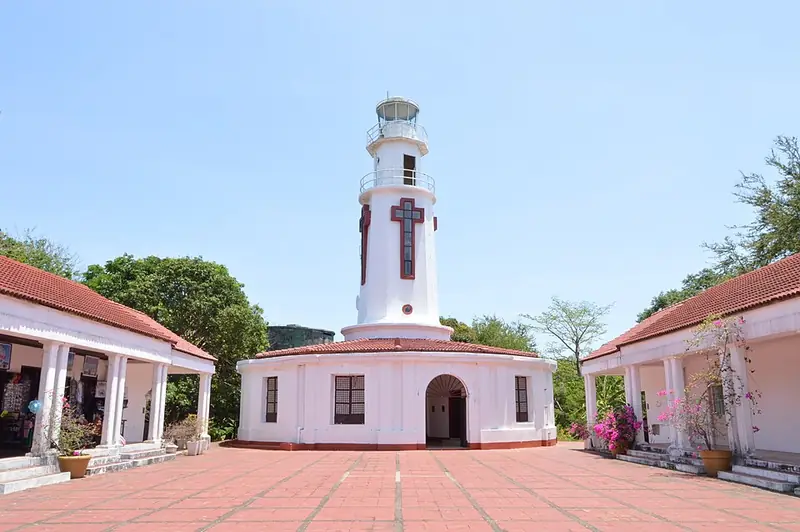
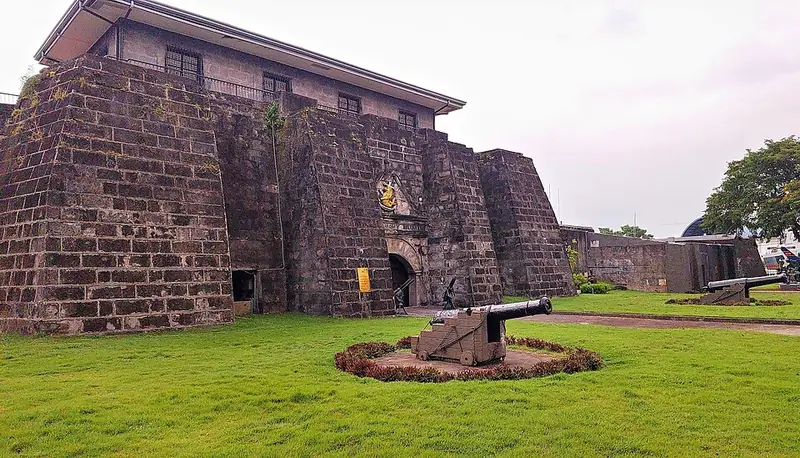
The old port city of Cavite retains 19th-century street layouts, Spanish-era churches, and the remnants of its naval infrastructure. The Chabacano-speaking community is concentrated here. The San Roque Church and the remnants of the old fortifications are the main heritage structures.
Tejeros, San Francisco
The site of the 1897 Tejeros Convention that elected Aguinaldo over Bonifacio. A small historical marker and monument commemorate the event. The site is in San Francisco municipality and is rarely visited — a quiet pilgrimage for those interested in the revolution's internal politics.
The Window in Kawit
On June 12, 1898, Emilio Aguinaldo stood at an upper window of his house in Kawit and read a declaration of independence to a crowd in the street below. The Philippine flag was unfurled for the first time. A band played a march that became the national anthem. The Spanish had effectively already lost — Dewey's fleet had destroyed their navy six weeks earlier — but the act of reading the declaration from that specific window mattered. Someone had to say it.
What Aguinaldo did not say, from that window or anywhere else, was what had happened in the forest of Maragondon two months earlier. In May 1898, Andres Bonifacio — the supremo who had launched the revolution with the tearing of cedulas in Caloocan — was executed on Aguinaldo's orders, convicted by a revolutionary court on charges of treason that most historians consider fabricated or at least vastly exaggerated. He was shot in a ravine near Maragondon at the age of 33.
The window in Kawit is preserved behind glass now, in a house that is a museum. The flag that was unfurled that day is in the museum's collection. Schoolchildren visit on field trips and take photographs. The question of what was paid for the independence declared from that window is not displayed on any museum placard, but it is not entirely absent from the room either. History in Cavite is close enough to touch and complicated enough that touching it carefully matters.