Map

Davao del Norte

Davao Region
Mindanao
Capital Tagum City
Population 1,046,236
Area 3,463 km²
Municipalities 8
Cities 3
Island Group Mindanao
Languages Cebuano, Mandaya, Ilocano

Davao del Norte is a province in the Davao Region of southeastern Mindanao, north of Davao City. Its capital, Tagum City, has been among the fastest-growing cities in the Philippines for over a decade — a mid-sized urban center built on agricultural commerce and expanding services. The province is an agricultural powerhouse: banana and pineapple plantations dominate the lowlands, with Cavendish banana export a major industry tied to global supply chains.

Tagum CityCapital
3,463 km²Area
8Municipalities
3 (Tagum, Island Garden of Samal, Panabo)Cities
MindanaoIsland Group
Davao (XI)Region

Agriculture and Urban Growth

The province's agricultural economy centers on Cavendish bananas — most of the bananas sold under Dole and other international brands from the Philippines are grown in the lowlands of Davao del Norte and adjacent provinces. Pineapple and rubber are also significant crops. The agricultural wealth generated by these plantations has funded Tagum City's growth as a commercial and services hub for the northern Davao Region.

Did You Know?

The Island Garden City of Samal (IGACOS) in Davao del Norte is a city occupying Samal Island in Davao Gulf, just 15 minutes by boat from Davao City. It is one of the Philippines' most accessible island city destinations, with white-sand beaches and dive sites.

Davao del Norte was created in 1967 when the original Davao Province — a massive administrative unit — was divided into three separate provinces. Its location north of Davao City and south of the Liangan Bay gives it a strategic agricultural corridor and coastal access along Davao Gulf.

The area that became Davao del Norte was part of the vast Davao frontier opened to agricultural settlement in the late 19th and early 20th centuries. Japanese settlers played a major role in developing abaca and hemp cultivation in the pre-war period, a history that has complicated the province's World War II narrative.

Late 1800s

Colonial Settlement Begins

Spanish colonial authorities encourage settlement of the Davao Gulf area. Indigenous Bagobo, Mandaya, and other Lumad peoples are progressively displaced from lowland areas as agricultural development proceeds.

1900s–1930s

Japanese Agricultural Settlement

Japanese settlers — many coming through formal immigration programs — develop large abaca and hemp plantations in the Davao area, including what is now Davao del Norte. By the 1930s, Japanese nationals are the largest single ethnic group of landowners in the Davao district.

1941–1945

World War II and Japanese Occupation

Japanese forces occupy Davao almost immediately after Pearl Harbor in December 1941. The existing Japanese community becomes part of the occupation administration. Guerrilla resistance continues throughout the war. Liberation in 1945 brings severe damage to commercial and agricultural infrastructure.

1967

Province Established

Davao del Norte is formally established as a separate province when the original massive Davao Province is divided into Davao del Norte, Davao del Sur, and Davao Oriental.

1998

Tagum Becomes a City

Tagum, the provincial capital, is converted from a municipality to a city. Subsequent decades of rapid growth in commerce, services, and population confirm the city's emergence as a major urban center in Mindanao.

Davao del Norte is culturally diverse, reflecting the layers of settlement that characterize the Davao Region: Lumad indigenous peoples in the highlands and some coastal areas, Visayan migrants and their descendants in the lowlands and cities, and Moro Muslim communities in some coastal barangays. Cebuano is the dominant language of everyday communication.

Lumad Heritage

The Mandaya people are the primary Lumad group in Davao del Norte. Mandaya culture includes the dagmay textile — a hand-woven abaca cloth with geometric patterns in earth tones — and the ritual music of the kutyapi (a two-stringed boat lute) and kulintang gong ensemble. Mandaya communities in the province have worked to document and maintain their cultural practices under pressure from agricultural development and migration.

Tagum Musikahan

The Musikahan sa Tagum festival is an annual music competition and showcase held in Tagum City, celebrating the province's cultural diversity. It has become one of the more significant cultural events in the Davao Region.

The Kadayawan Festival — the major cultural celebration of the wider Davao Region — has roots in Davao del Norte as well as Davao City. It celebrates the harvest and honors the indigenous peoples of the region, with street dancing, floral floats, and cultural performances from various Lumad groups.

The food of Davao del Norte follows the Cebuano-Mindanao tradition, with the abundance of a major agricultural province available in markets and kitchens. Bananas appear in multiple forms beyond the raw fruit — banana blossom (puso ng saging) is cooked as a vegetable; saba bananas are fried, boiled, or made into desserts. Pork, fresh seafood from Davao Gulf, and abundant tropical produce are the foundations.

Tinolang Isda sa Gata

Fish cooked in coconut milk with ginger, green papaya, and malunggay (moringa) leaves. The Davao del Norte version uses fresh-caught fish from the gulf or freshwater varieties from rivers. The coconut milk is light rather than thick, making this a brothy dish closer to a soup.

Puso ng Saging Kare-Kare

A vegetarian variation of the classic Filipino kare-kare, using banana blossom in place of meat. The banana blossom is braised in peanut sauce with eggplant and banana heart, served with bagoong alamang on the side. In a province of banana plantations, the blossom is free — it is cut from the bunch before harvest.

Inun-unan na Isda (Sour-Braised Fish)

Cebuano-Mindanao tradition
15 minutesPrep
25 minutesCook
4Serves
Ingredients
  • 600gFish (tilapia, bangus, or any firm fish), whole or steaks
  • ½ cupCoconut vinegar
  • 1 cupWater
  • 2 thumbs, slicedGinger
  • 1, slicedOnion
  • 4 cloves, crushedGarlic
  • 3Long green chili
  • to tasteSalt
  • ½ teaspoonBlack pepper
Method
  1. Combine vinegar, water, ginger, onion, garlic, salt, and pepper in a wide pan. Bring to a simmer.
  2. Add fish. Do not stir — let the liquid come back to a simmer.
  3. Cover and cook over medium heat 15–20 minutes, turning fish once halfway through.
  4. Add chilies in the last 5 minutes.
  5. The liquid should reduce to a concentrated sour-savory sauce by the end. If still too liquid, simmer uncovered a few minutes more.
  6. Serve with rice.
Cook's note

Inun-unan is essentially escabeche without frying — a vinegar braise that both cooks and lightly preserves the fish. It keeps refrigerated for two days, the flavor intensifying as it rests.

Tropical Fruit

Davao del Norte's markets carry exceptional tropical fruit — pomelo, mangosteen, rambutan, durian, and varieties of banana unavailable elsewhere. The Tagum City market is the place to explore the full range. Durian season is June to September.

Cebuano is the dominant language of Davao del Norte, spoken by the majority of the lowland and urban population descended from Visayan settlers. Mandaya and other Lumad languages are spoken by indigenous communities in highland and upland areas. Tagalog and English are used in government, education, and formal settings.

CebuanoPrimary language
Mandaya, Bagobo-TagabawaIndigenous
Tagalog, Filipino, EnglishOther
Tagum City (multilingual)Urban center

The linguistic diversity of the province reflects its settlement history. In Tagum City, you can hear Cebuano, Tagalog, Ilocano, Hiligaynon, and Mandaya on the same morning in the same market. This mix is characteristic of Mindanao frontier cities built by migration from multiple origin points.

Davao del Norte is reached from Davao City — the regional hub with an international airport — about 50–80 kilometers to the south. Tagum City is a 1–1.5 hour drive from Davao City on the national highway. The province is also a stopping point on the route north through Mindanao toward Bukidnon and the Cagayan de Oro–Manila highway.

1–1.5 hours to TagumFrom Davao City
Francisco Bangoy Int'l, Davao CityNearest airport
15 min boat from Davao pierIsland Garden City of Samal
March–June (drier season)Best months

Island Garden City of Samal (IGACOS)

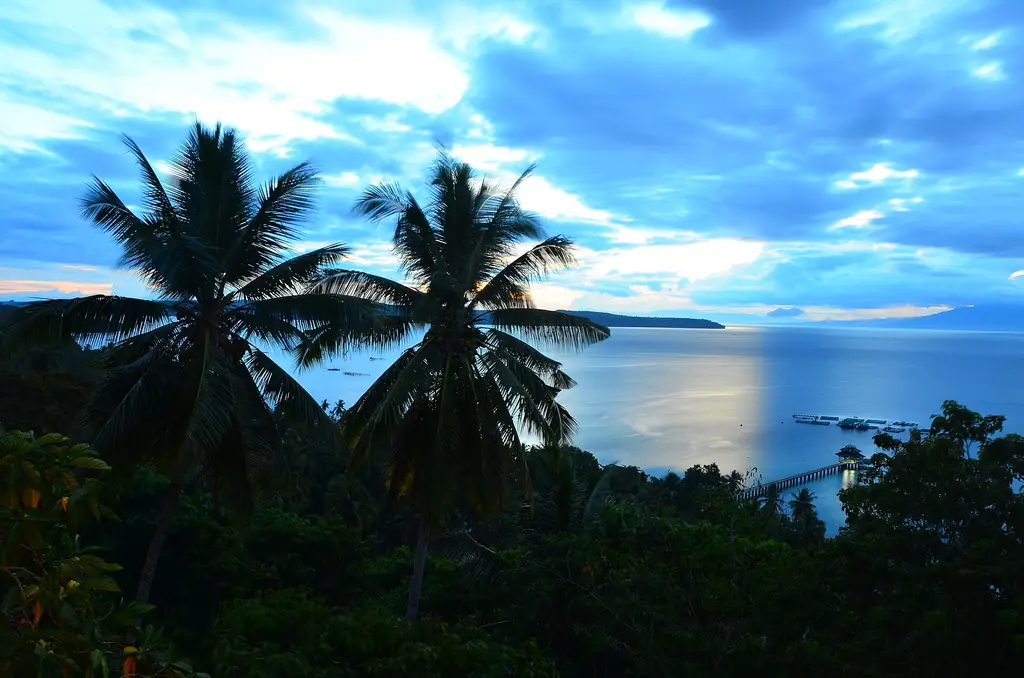
Samal Island in Davao Gulf is technically its own city within Davao del Norte. It is 15 minutes by motorized banca from the Sasa pier in Davao City. The island has white-sand beaches, dive sites with World War II wrecks, and resort infrastructure ranging from budget to upscale. Hagimit Falls in the island interior provides a freshwater swimming option.

Tagum City Rizal Park and Libi Lake

The center of Tagum City is organized around a public park system that includes Libi Lake — a small lake within city limits that has been developed as a recreation area with walking paths and food stalls. The city's rapid development is evident in its modern commercial buildings alongside older low-rise commercial strips.

Banana Plantation Country

The lowlands of Davao del Norte — particularly around Panabo City and the municipalities — are covered in Cavendish banana plantations. Driving through this landscape conveys the scale of Philippine export agriculture. Panabo City has developed a small agri-tourism circuit including plantation visits through local government.

Mandaya Weaving Communities

Highland communities in the municipalities of New Corella and Asuncion maintain Mandaya weaving traditions. Visits require arrangement through local government units or indigenous peoples organizations. Dagmay cloth — the traditional Mandaya weave in geometric patterns — can be purchased directly from weavers.

The Fastest-Growing City You've Never Heard Of

In 2013, the Philippine Statistics Authority ranked Tagum City among the fastest-growing cities in the country by income. Development economists who study secondary cities in Mindanao use Tagum as a case study. Real estate brokers from Manila call it an opportunity. None of this is visible from the highway going through town, where the commercial strip looks like every other provincial Filipino city — Jollibee, a palengke, hardware stores, money-changers, cell phone repair shops.

What is underneath the surface is the banana industry. Every week, refrigerated containers leave Panabo port bound for Japan, South Korea, and the Middle East. The bananas are Cavendish, a variety developed after the Gros Michel banana was wiped out by Panama disease in the 1950s. The workers who harvest them are largely migrants from Visayas, employed by transnational corporations on land that was Mandaya ancestral territory before the settlers arrived.

On Samal Island, fifteen minutes from Davao City by banca, the tourism economy runs on the same gulf that the cargo ships cross. Resorts have opened on beaches that fishing communities used to have to themselves. The bangkeros who run the boats know both worlds — the tourist from the city who wants to snorkel, and the supply vessel going the other direction loaded with bananas. The gulf holds all of it.