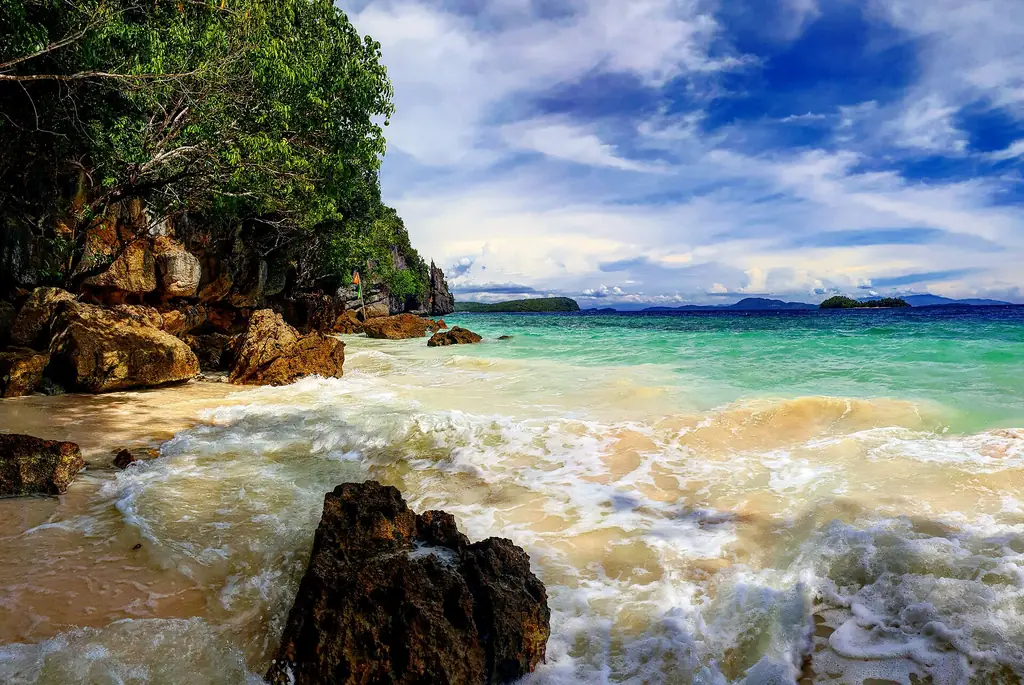
The Dinagat Islands sit north of Surigao del Norte in the Mindanao Sea, a chain of islands separated from the Surigao coast by the Dinagat Sound. The province was formally declared in 2006 after a protracted legal struggle, and its existence as a province has been contested and reaffirmed multiple times through the courts.
San JoseCapital
802 km²Area
7Municipalities
MindanaoIsland Group
San Jose is the provincial capital, a small town on the main island of Dinagat. The island group includes Dinagat Island, Hibuson Island, and several smaller islands. The economy runs on nickel mining, fishing, and coconut farming — a combination that defines the material life of the province.
★
A Province That Almost DisappearedThe Supreme Court ruled in 2010 that Dinagat Islands did not meet the minimum land area requirement to be a province. The ruling would have dissolved the province and returned its municipalities to Surigao del Norte. The decision was reversed after a motion for reconsideration, and the province survived — but the episode illustrates how recently and narrowly its existence as a separate entity was established.
Dinagat is one of the smallest provinces in the Philippines by both area and population. It has a frontier quality — a place where institutions are new, infrastructure is incomplete, and the landscape retains the character of an island chain that development has not yet fully reorganized.
The islands were known to Spanish navigators as part of the broader Surigao maritime zone. Fishing and limited trade characterized early settlement. The islands served as a refuge — their position in the Mindanao Sea and their difficult terrain made them useful for communities wanting distance from colonial authority.
Pre-colonialMamanwa and Early Settlement
The Mamanwa people, considered among the earliest inhabitants of Mindanao, had communities in the Surigao-Dinagat area. They are a Negrito group with cultural and physical characteristics distinct from later Austronesian migrants.
1900sPart of Surigao del Norte
Through the American period and into the twentieth century, the Dinagat Islands were administered as part of Surigao del Norte. Mining interests began surveying the islands for nickel deposits in the latter half of the century.
1960s–1990sNickel Mining Development
Large-scale nickel mining operations were established on Dinagat Island. The Nonoc Island nickel smelter across the Surigao Strait became one of the largest in Asia before closing in the 1980s. Dinagat's own mining activity continued at smaller scale.
2006Province Declared
Republic Act 9355 created the Province of Dinagat Islands from Surigao del Norte. The first provincial election was held in 2007. Legal challenges immediately followed, with opponents arguing the new province failed the minimum area and income requirements.
2010–2011Supreme Court Rulings
The Supreme Court twice ruled on the province's constitutionality — first dissolving it, then reinstating it. The second ruling, affirming provincial status, settled the matter. The Ecleo political family, prominent in Surigao, had been closely involved in the push for provinchood.
Dinagat's culture is shaped by its maritime character. People move between islands by boat as a matter of daily life, and the rhythms of fishing — tide, season, species — organize time in ways that agricultural calendars do not.
The population is predominantly Surigaonon-speaking Christian, with cultural practices closely aligned with those of Surigao del Norte. Folk Catholicism is deeply embedded — fiestas, patron saint celebrations, and religious processions punctuate the year in every municipality.
★
The PBMA and Ruben EcleoThe Philippine Benevolent Missionaries Association (PBMA), a religious organization founded by Ruben Ecleo Sr., has a significant presence in the Dinagat Islands and wider Surigao area. Ecleo Sr. claimed divine status and built a large following. The organization remains active, and the Ecleo family has been politically dominant in Dinagat since its founding as a province.
Fishing communities on the islands maintain traditional knowledge of the Mindanao Sea — current patterns, fishing grounds, seasonal movements of species. This knowledge is practical rather than ceremonial but is no less a form of cultural inheritance passed through families across generations.
Seafood is the foundation of the Dinagat diet. The islands sit in productive fishing waters, and the daily catch — reef fish, squid, crab, shrimp — is the most reliable protein source. Coconut, grown widely on the islands, appears in nearly every local preparation.
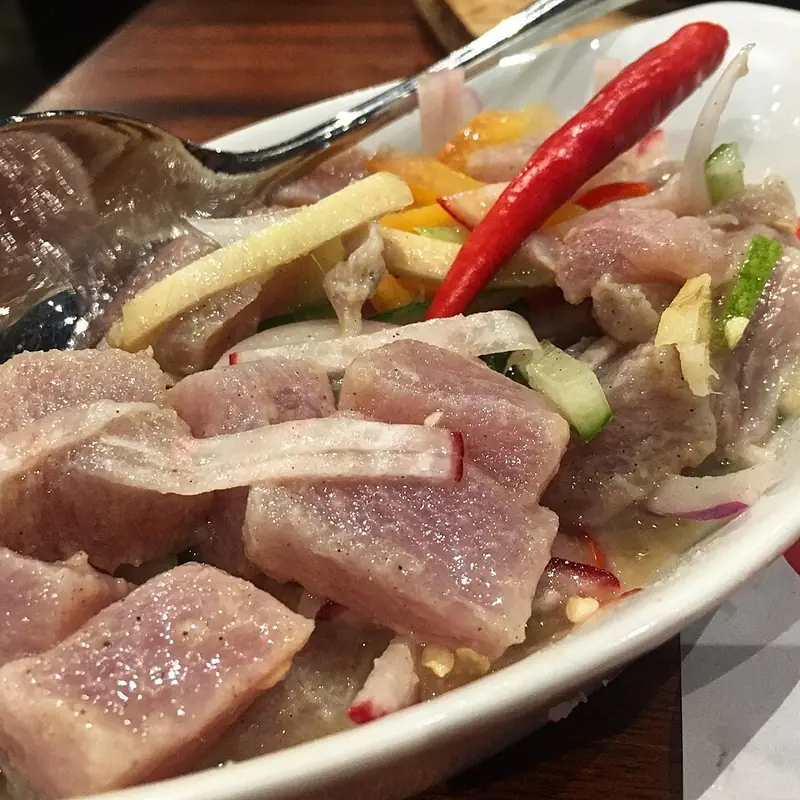
Kinilaw na Isda
The Surigao-Dinagat version of ceviche, made with reef fish cured in local coconut vinegar with ginger, onion, and chili. The quality depends entirely on the freshness of the fish — in Dinagat, the fish is typically from the morning's catch.
Utan nga Liso
A Bisaya vegetable soup made with locally available greens — usually a combination of whatever is growing in the garden or gathered from the hillside. In island communities, it often includes purslane, sweet potato tops, and young moringa leaves in a light broth.
15 minutesPrep
25 minutesCook
4Serves
Ingredients
- 1 kgblue crab (alimasag), cleaned and halved
- 400mlcoconut milk
- 200mlcoconut cream
- 5 clovesgarlic, minced
- 1 mediumonion, chopped
- 1 thumbginger, sliced
- 4 pieceslong green chili
- 2 tbspfish sauce
Method
- Sauté garlic, onion, and ginger in a wide pan.
- Add crab pieces and stir briefly until shells begin to turn orange.
- Pour in coconut milk and bring to a simmer.
- Add green chili and fish sauce.
- Cook for 10 minutes until crab is fully cooked.
- Pour in coconut cream and stir. Simmer for another 5 minutes until sauce thickens.
- Taste and adjust with fish sauce. Serve with rice.
Cook's noteFresh crab is essential. Frozen crab loses too much moisture and turns the dish watery. If using large crabs, score the shells before cooking to allow the coconut milk to penetrate.
Surigaonon is the primary language of Dinagat Islands, part of the broader Bisaya language family and closely related to Cebuano. It is the language of daily life, market, church, and local government across all seven municipalities.
SurigaononPrimary Language
CebuanoRelated Language
Austronesian / BisayanLanguage Family
Caraga (Region XIII)Region
Surigaonon is mutually intelligible with Cebuano but has its own vocabulary, phonology, and idiomatic expressions. Speakers from Dinagat can communicate easily with Cebuano speakers from Davao or Cebu City, but the regional identity expressed through Surigaonon is distinct and locally valued.
Filipino and English are used in schools and in national government communication. The older generation of fishing communities often has limited formal education and may have weaker competency in Filipino than in Surigaonon.
Dinagat Islands is reached by ferry from Surigao City, which is itself connected to Cebu City and other Visayan ports. The crossing from Surigao takes roughly an hour by fast craft to San Jose. Travel within the island group requires additional boat transport.
~35 km by seaDistance from Surigao City
45–60 minutesFerry Travel Time
Multiple operators from Surigao PortFerry Operator
Surigao Airport, Surigao CityNearest Airport
Cagdianao Crystal Cave
A cave system in the municipality of Cagdianao containing crystal formations. The cave is accessible with local guides and offers a geological contrast to the maritime landscapes that dominate the province.
Libjo Beach
White sand beach in Libjo municipality with clear water and minimal development. Accommodation is basic — homestays are the primary option. The beach is best visited on a day trip from San Jose.
Loreto Waterfalls
A series of waterfalls accessible from the municipality of Loreto in the interior of Dinagat Island. The trail passes through second-growth forest and coconut groves. Local guides from the barangay are required.
✦
Ferry SchedulesFerry schedules from Surigao to San Jose are not always predictable — weather, demand, and operator decisions all affect departure times. Check with the Surigao port terminal on the day of travel. Accommodation in San Jose is limited; coordinate your stay before arriving.
The Dinagat Islands became a province in 2006, was dissolved by the Supreme Court in 2010, and was reinstated by the same court a year later after a motion for reconsideration. For those twelve months between dissolution and reinstatement, it existed in a legal limbo — elected officials who had won seats in a province that no longer officially existed, residents of a place that the national government was uncertain how to categorize.
The case turned on population and land area requirements set in the Local Government Code. Dinagat did not meet the standard population figure. But there is a provision exempting island provinces from the standard land area requirement — and the courts eventually agreed that this provision applied. What the case revealed was the degree to which the existence of a province depends not just on geography and community but on the precise wording of statutes and the composition of the court at a given moment.
For the fishing families of Cagdianao and the coconut farmers of Libjo, the legal proceedings were remote from daily life. They had lived on these islands, fished these waters, and buried their dead in these municipal cemeteries whether the province existed or not. The provincial government, new as it was, had begun building roads and hiring staff. When the court reinstated it, the work resumed. Whether that work will accumulate into something durable over the coming decades is the actual open question — not the legal one.