Map

Tawi-Tawi

BARMM
Mindanao
Capital Bongao
Population 467,027
Area 1,087 km²
Municipalities 11
Cities 0
Island Group Mindanao
Languages Tausug, Sama-Bajau, Filipino

Tawi-Tawi is the southernmost province of the Philippines — a cluster of more than 300 islands at the end of the Sulu Archipelago, closer to Malaysia's Sabah coast than to Manila. It faces the Celebes Sea to the south and the Sulu Sea to the north, and its southernmost island, Sibutu, is separated from Borneo by a narrow strait.

BongaoCapital
1,087 km²Area
11Municipalities
MindanaoIsland Group

The Sama-Bajau people — the sea nomads of maritime Southeast Asia — are the dominant cultural group of Tawi-Tawi. The Bajau Laut (Sama Dilaut), as they are called, have lived on boats or stilt houses over the water for centuries, maintaining a maritime culture that is one of the most distinctive in the world. Their knowledge of the sea, the tides, and the fish of the Sulu and Celebes is without parallel.

The Sea People

The Bajau Laut of Tawi-Tawi are renowned as the world's deepest free divers — capable of holding their breath for up to thirteen minutes and diving to depths exceeding 60 metres without equipment. DNA studies have found that the Bajau people have genetically larger spleens than land-dwelling populations, giving them greater oxygen storage capacity. Their relationship to the sea is biological as well as cultural.

At the Edge of the Sultanate

Tawi-Tawi's islands were within the sphere of influence of the Sulu Sultanate — the archipelago's southernmost extension of the sultanate's maritime network. The Sama and Bajau peoples who inhabited the islands were not exactly subjects of the sultanate but existed in a relationship of mutual benefit and occasional tension: the sultanate provided protection and trade access, the sea peoples provided labour, fish, and maritime intelligence.

1878

Spanish Claim and Bornean Connection

Spain's claim to Tawi-Tawi became entangled with British North Borneo Company's claims to Sabah — both based on agreements with the Sulu Sultanate. The Treaty of 1878, in which the Sultan of Sulu granted certain rights to the British North Borneo Company, produced a territorial ambiguity that the Philippines maintains as a claim to Sabah to this day.

1973

Tawi-Tawi Province Established

Tawi-Tawi was constituted as a separate province from Sulu in 1973 — the Marcos administration's reorganisation of the Sulu archipelago into two provinces. Bongao, the largest population centre, became the capital. The province's position as the southernmost in the Philippines made it strategically significant in the Bangsamoro conflict.

2019

BARMM Establishment

Tawi-Tawi, as part of the Bangsamoro Autonomous Region in Muslim Mindanao (BARMM), came under the administration of the Bangsamoro Transitional Authority following the ratification of the Bangsamoro Organic Law. The province is fully within the BARMM governance framework, reflecting its predominantly Muslim population and its longstanding inclusion in the Bangsamoro political identity.

Tawi-Tawi's culture is maritime Islamic at its core. The Sama-Bajau communities — both the land-dwelling Sama and the boat-dwelling Bajau Laut — maintain traditions of music, weaving, and boat-building that represent some of the oldest surviving material culture of maritime Southeast Asia. The province is the living centre of the Sama musical tradition.

The Kulintang of Tawi-Tawi

The Sama people of Tawi-Tawi are the originators — or the most accomplished practitioners — of the kulintang gong ensemble tradition of the southern Philippines. The kulintang as played in Tawi-Tawi is distinguished by its complex rhythmic patterns and the specific playing technique developed by Sama musicians. The tradition was recognised by the National Commission for Culture and the Arts as a living heritage of national significance.

Pangalay Dance — Tawi-Tawi Style

The pangalay dance tradition reaches its most complex form in Tawi-Tawi, where generations of Sama royal performers developed an elaborate vocabulary of hand and wrist movements that represent the highest form of classical dance in the Sulu Archipelago. The tradition was transmitted through the Sama royal courts and is now maintained by cultural organisations in Bongao.

Bajau Boat Building

The lepa — the traditional houseboats of the Bajau Laut — are built without nails using woodworking techniques passed through generations of boat-builders. The lepa is not just a vessel but a home, a symbol of identity, and a demonstration of craftsmanship. The annual Regatta de Zamboanga in Zamboanga City features lepa boat races as a central event.

Tawi-Tawi's food is entirely halal — pork is absent from the province's cuisine. The sea provides the primary protein: the rich fisheries of the Sulu and Celebes Seas deliver an extraordinary variety of reef and pelagic fish, with tuna, grouper, snapper, and shellfish forming the base of everyday cooking. The Malay and Indonesian influences on Tawi-Tawi's cuisine are more pronounced here than anywhere else in the Philippines.

Tiyula Itum (Sama Version)

The black soup of the Tausug and Sama traditions — dark, smoky, built on burned coconut and local spice. The Sama version in Tawi-Tawi uses reef fish rather than the beef or chicken of the Sulu mainland version. The burned coconut base gives the broth its characteristic dark colour and the smoky depth that defines the dish. A royal dish, served at celebrations.

Piaran (Sama Fish Curry)

Fresh fish cooked in coconut milk with turmeric, lemongrass, ginger, and local spice. The Sama version in Tawi-Tawi is closer in composition to the Malaysian ikan masak lemak than to any other Philippine fish preparation — a reflection of the historical connections between the Sama world and the Malay archipelago. Served with steamed rice and pickled vegetables.

Bongao Market

Bongao's waterfront market — active from before dawn — is the best introduction to Tawi-Tawi's food culture. The variety of fresh seafood reflects the province's position at the junction of the Sulu and Celebes Seas. The cooked food stalls around the market serve halal breakfast from early morning: fish, rice, and strong black coffee.

Sinama — the language of the Sama people — is the dominant mother tongue of Tawi-Tawi, spoken across multiple dialects corresponding to the different island groups of the province. Tausug is also widely spoken as a trade language. Arabic is used in religious contexts — the mosques, the madrasas, and the Quranic recitation that marks daily life across the province.

Sinama — The Sea Language

Sinama is a member of the Sama-Bajau branch of the Austronesian language family — a branch that linguists have studied for its evidence about the ancient dispersal of maritime peoples across the western Pacific and Indian Oceans. The language has a rich maritime vocabulary: dozens of words for types of waves, sea conditions, fish behaviour, and navigation by stars that have no equivalents in Filipino or English.

A Language Across Borders

Sinama is spoken not only in Tawi-Tawi and the Sulu Archipelago but also in parts of Malaysia's Sabah, Indonesian Sulawesi, and the island communities of Borneo. The Sama-Bajau linguistic community is one of the most geographically dispersed in Southeast Asia — the same language family connects communities from the Philippines to Indonesia across thousands of kilometres of sea.

Tawi-Tawi is reached by air from Zamboanga City — a flight of about one hour to Sanga-Sanga Airport near Bongao. Travel to Tawi-Tawi requires attention to current security advisories, as parts of the Sulu Archipelago remain affected by the activities of armed groups. The province itself — particularly Bongao — has been relatively stable, but the situation requires monitoring.

~1 hr (air)From Zamboanga
Sanga-Sanga Airport (Bongao)Airport
Check before travelTravel advisory
BARMMRegion

Bongao Peak

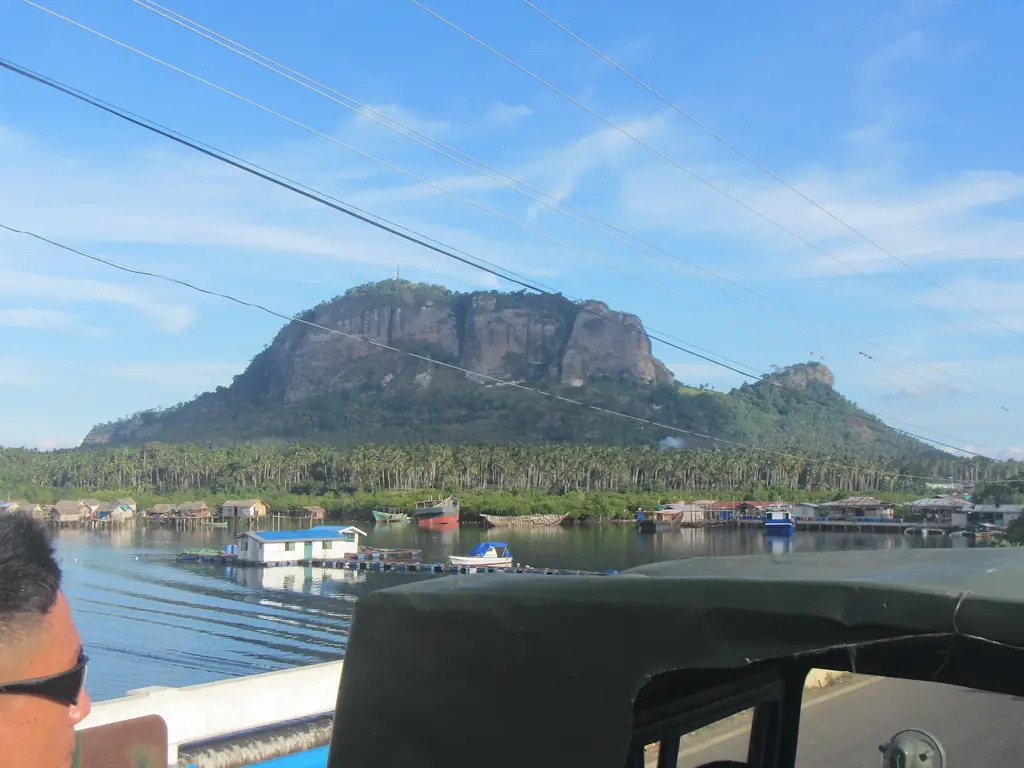
The forested limestone peak above Bongao town — a sacred site for both the Muslim community and for the Sama people, home to macaques that are considered sacred and must not be harmed. The view from the summit covers the Tawi-Tawi island chain, the Sulu Sea to the north, and on a clear day, the coast of Borneo to the south.

Simunul Island

The site of the oldest mosque in the Philippines — the Sheik Makhdum Mosque, built in 1380 CE, predating the Sulu Sultanate and representing the first arrival of Islam in the Philippine archipelago. The current mosque is a reconstruction of the original, but the site preserves the oldest continuously used place of Islamic worship in the country.

Tandubas Island

One of the inhabited islands of Tawi-Tawi with white sand beaches and clear water — the kind of island that makes the Philippine claim to 7,641 islands feel real rather than statistical. Reached by boat from Bongao. The island community is Sama.

Visiting Tawi-Tawi Responsibly

Travel to Tawi-Tawi without a local contact or established community connection is not recommended. Researchers, journalists, and travellers with genuine purpose are welcomed by the Bongao community. The Provincial Tourism Office can provide guidance on current conditions and appropriate protocols for visiting island communities.

The Oldest Mosque

In 1380 CE — more than a century before Columbus crossed the Atlantic, more than 150 years before Ferdinand Magellan was killed at Mactan — a Muslim scholar named Sheik Makhdum arrived at the island of Simunul in what is now Tawi-Tawi and built a mosque. It was the first mosque in the Philippine archipelago, and it is still there.

The current structure is a reconstruction of the original palm-and-wood building, built on the same ground. The wooden pillars of the original structure are preserved under the reconstruction — physical evidence of an act of faith performed six and a half centuries ago at the edge of the known world. Islam arrived in the Philippines from the south, not from the west: it came up from Borneo and Malacca on trading vessels before the Spanish arrived from the Americas with their own religion.

The Philippines is introduced to most of its own citizens through the Spanish colonial narrative — the churches, the friars, the cross at Magellan's shrine in Cebu. Simunul offers the other side of the story: the Islam that was here first, the traders who came before the soldiers, and the mosque that has outlasted everything the Spanish tried to build in the south. The oldest continuously sacred site in the Philippines is not a church.